Showing posts with label energy. Show all posts
Showing posts with label energy. Show all posts
Wednesday, 13 April 2022
Reducing Fridge Energy Consumption
(very old draft)
For about 12 months our family has tried to reduce our gas and electricity energy consumption. We use gas for hot water, wood for heating and we have no air conditioner so our main electricity consumer was our fridge. I confirmed this by measuring the energy that the fridge used.
We have an old fridge. It is an upside-down model and at least 15 years old - a Westinghouse Silhouette 411L RB411B.
In our situation - on the lowest [power] setting - it consumes about 1360WHr per day which consists of a constant load of 50mA (12.5W) and about 165W when the compressor is running. The power factor for the motor appears to be about 0.66 - of course these figures are rough and really just provide me with a baseline. The compressor typically operated for 11 minutes in every 41 or about 27% of the time.
I began by focusing on the constant 12.5W. What is it? The fridge is not a smart fridge so why does it constantly consume 50mA? This adds up to 300WHr per day or about 22% of the total energy consumption.
This fridge has a cooling plate in the upper section where the milk and eggs are kept. It seems that the design causes ice to build up on the plate which could, if not removed, reduce the efficiency of the fridge. To overcome this, a heating element was installed behind the plate to melt any ice when the compressor stops. The melted ice drips into a gutter and is drained to an evaporator above the motor.
So, I ripped it out. I could have just disconnected it, but I didn't.
Having removed the defrost element, I had to develop a plan to remove ice from the plate. I achieved this by placing the fridge on a timer which cut power for, initially, 3 hours from about 3AM. This didn't have a noticeable effect on the operating range of the fridge and it allowed enough time for the ice to melt.
In theory, the fridge should now consume about 1060WHrs - a big difference. But shouldn't it reduce the energy consumed by more than 12.5W because the heating energy must then be pumped out the next time the compressor runs? If the compressor is like an air-conditioner, then the cooling efficiency is about 2.5 which means that it should take 5W to remove the heat from the defrost element. Therefore the reduction should be more like 17-18W or 410-430WHr per day.
My records aren't the best, but I think the fridge now consumed 950WHr per day based on a duty cycle of 24%.
My next thought was to insulate the fridge. As I said, it is an old fridge and has the radiator elements on the outside and about 25mm from the back of the fridge. I placed a blanket between the radiator and the fridge and I draped a doona (light weight polyester blanket) over the sides of the fridge. This also had an effect. The on-time reduced to 9 minutes in 43 minutes or about 21%.
The result is an average energy consumption of 810WHr per day - down 40% from my unmodified fridge.
My current challenge is to see if I can do better by controlling when the fridge can operate. The idea is that thermostat is too sensitive and operates when the door is opened and the fridge looses it's cold air. My calculations suggest that the warmer air from the room doesn't take much energy to get down to normal fridge temperatures so by making the thermostat a secondary temperature controller I hope to reduce the energy consumption further. It also allows me to have two defrost periods during a day and to ensure that the fridge has plenty of time to adjust to post meal activity as warm foods and goods are placed back into the fridge.
Initial results are promising: without insulation the fridge is consuming about 800WHr per day, so with insulation it should be even lower. The fridge is operating between 4 and 9 degrees Celsius and typically between 5 and 8 degrees.


Wednesday, 21 January 2009
DIY Super-Efficient Fridge Uses 0.1 kWH a Day - Can it really be that good?
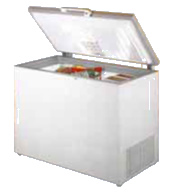
I was skeptical that a chest freezer could be modified to perform the function of a refrigerator and only use 0.1 kWh per day. The home site for this 2005? modification is here. now on Wayback here. 
 Firstly, the chest freezer selected is a very efficient one to begin with. The VestFrost SE255 is rated as a 5-star, 247L chest freezer that has been tested to AS/NZS4474 to use 237kWh per year. AS/NZS4474, as I understand it, operates the freezer at -15C in an ambient temperature of 32C. It probably cost Tom around $1500.
So this chest freezer uses, according to the standard test, 237/365 or 649Wh per day. It's dimensions are 1260 mm W x 850 mm H x 600 mm D displacing a volume of 643L. Allowing for a compressor void of 600 mm x 300 mm x 300 mm, the thickness of the sides and door must be about 135mm. So this freezer does have some serious insulation to keep it cool.
The basic conversion is to add another thermostat device that keeps the inside of the freezer at somewhere above freezing so it becomes a fridge. Tom, the author, set the internal temperature to about 5.5C on average.
Tom is of the opinion that this idea works because chest freezers have better insulation and that when the door is opened, cold air does not rush out. Tom is right, but the real reason that his fridge consumes so little power is due to the temperatures he is operating it in.
Chest freezers, especially the SE255, do have thicker insulation.
Vertical refrigerators do loose cold air when the door is opened. But if this chest freezer were to be stood on end so the cold air could drain away, the fridge would only use a small fraction of 1Wh of energy to cool the ambient air back down to 5.5C.
If the freezer is empty and all the air is replaced then the freezer needs to cool it down by 12.5C in Tom's case. 247L of air weighs about 0.32 kg. The heat capacity of air is about 1000J/kg/K. So the fridge needs to remove 4000J to cool this air down to 5.5C.
Now, if I am right with my physics, the electrical energy required to pump energy out of a fridge is:
E = Heat * ( T.hot - T.cold ) / ( T.cold * M.eff )
If the motor efficiency (M.eff) is 90%, Heat is 4000 J, T.hot is 291.15K and T.cold is 278.65 K and the the electrical energy required is 199J or 55mWh (that is 55 milli-Watt hours) - a small amount.
Others have noted this small amount also.
Now, the warm air may cool a little upon entering the fridge and this cooled air may also drain away, but since the 'energy' lost is so low it makes little difference.
The real reason for the low energy use is the operating temperatures: average ambient of 18C and internal temperature of 5.5C on average.
By my calculations, and I am no expert here, the freezer would consume just 6.6% of the energy it does when tested to AS/NZS4474.
So it should use 0.066 * 649 = 43Wh. Tom stated that the fridge used 103Wh on the first day and that 30% of this was during the stocking/re-arranging period. So my math does not seem to be too far out.
What would happen if we operated an energy efficient vertical fridge at Tom's temperatures?
Let's pick an Electrolux ERM4307. It is a 6 star 400L fridge (actually it is better than that but the star scale only goes to 6) that is tested to consume 250 kWh per year or 685 Wh per day when operated (closed) at 32C with in internal temperature of 3C. Its volume is about 887L.
Again allowing 63L for the compressor, the insulation is probably about 120mm thick.
By my calculations it would use just 18.4% of 685Wh which is 126Wh per day and the fridge is about 70% larger inside than the SE255.
So the chest freezer is still better, but a good vertical fridge can use very little energy too in Tom's environment.
Electrolux also make a vertical freezer. The EFM3607 which is tested to use 403kWh per year which is 1.1 kWh per day. When operated in Tom's environment it should use just 6.6% of 1.1kWh which is 72Wh per day.
This fridge/freezer pair will set you back roughly $3600.
So, to reduce your fridge/freezer running costs you need to start with an efficient fridge and freezer. Then keep them in a cool place with good ventilation. If you want to you can raise the internal set point to further reduce running costs - I would stay under 8C and definitely under 10C.
To get an idea of the energy saving that you can make by changing the operating temperatures of your fridge or freezer, I have made this graph that hopefully makes it easier to get an approximate energy reduction factor:
Select the inside temperature line, draw a line up from the ambient temperature axis to the internal temperature line and read off the energy factor (as a percentage). To use it, just multiply your fridge's daily/yearly energy consumption by this percentage.
Firstly, the chest freezer selected is a very efficient one to begin with. The VestFrost SE255 is rated as a 5-star, 247L chest freezer that has been tested to AS/NZS4474 to use 237kWh per year. AS/NZS4474, as I understand it, operates the freezer at -15C in an ambient temperature of 32C. It probably cost Tom around $1500.
So this chest freezer uses, according to the standard test, 237/365 or 649Wh per day. It's dimensions are 1260 mm W x 850 mm H x 600 mm D displacing a volume of 643L. Allowing for a compressor void of 600 mm x 300 mm x 300 mm, the thickness of the sides and door must be about 135mm. So this freezer does have some serious insulation to keep it cool.
The basic conversion is to add another thermostat device that keeps the inside of the freezer at somewhere above freezing so it becomes a fridge. Tom, the author, set the internal temperature to about 5.5C on average.
Tom is of the opinion that this idea works because chest freezers have better insulation and that when the door is opened, cold air does not rush out. Tom is right, but the real reason that his fridge consumes so little power is due to the temperatures he is operating it in.
Chest freezers, especially the SE255, do have thicker insulation.
Vertical refrigerators do loose cold air when the door is opened. But if this chest freezer were to be stood on end so the cold air could drain away, the fridge would only use a small fraction of 1Wh of energy to cool the ambient air back down to 5.5C.
If the freezer is empty and all the air is replaced then the freezer needs to cool it down by 12.5C in Tom's case. 247L of air weighs about 0.32 kg. The heat capacity of air is about 1000J/kg/K. So the fridge needs to remove 4000J to cool this air down to 5.5C.
Now, if I am right with my physics, the electrical energy required to pump energy out of a fridge is:
E = Heat * ( T.hot - T.cold ) / ( T.cold * M.eff )
If the motor efficiency (M.eff) is 90%, Heat is 4000 J, T.hot is 291.15K and T.cold is 278.65 K and the the electrical energy required is 199J or 55mWh (that is 55 milli-Watt hours) - a small amount.
Others have noted this small amount also.
Now, the warm air may cool a little upon entering the fridge and this cooled air may also drain away, but since the 'energy' lost is so low it makes little difference.
The real reason for the low energy use is the operating temperatures: average ambient of 18C and internal temperature of 5.5C on average.
By my calculations, and I am no expert here, the freezer would consume just 6.6% of the energy it does when tested to AS/NZS4474.
So it should use 0.066 * 649 = 43Wh. Tom stated that the fridge used 103Wh on the first day and that 30% of this was during the stocking/re-arranging period. So my math does not seem to be too far out.
What would happen if we operated an energy efficient vertical fridge at Tom's temperatures?
Let's pick an Electrolux ERM4307. It is a 6 star 400L fridge (actually it is better than that but the star scale only goes to 6) that is tested to consume 250 kWh per year or 685 Wh per day when operated (closed) at 32C with in internal temperature of 3C. Its volume is about 887L.
Again allowing 63L for the compressor, the insulation is probably about 120mm thick.
By my calculations it would use just 18.4% of 685Wh which is 126Wh per day and the fridge is about 70% larger inside than the SE255.
So the chest freezer is still better, but a good vertical fridge can use very little energy too in Tom's environment.
Electrolux also make a vertical freezer. The EFM3607 which is tested to use 403kWh per year which is 1.1 kWh per day. When operated in Tom's environment it should use just 6.6% of 1.1kWh which is 72Wh per day.
This fridge/freezer pair will set you back roughly $3600.
So, to reduce your fridge/freezer running costs you need to start with an efficient fridge and freezer. Then keep them in a cool place with good ventilation. If you want to you can raise the internal set point to further reduce running costs - I would stay under 8C and definitely under 10C.
To get an idea of the energy saving that you can make by changing the operating temperatures of your fridge or freezer, I have made this graph that hopefully makes it easier to get an approximate energy reduction factor:
Select the inside temperature line, draw a line up from the ambient temperature axis to the internal temperature line and read off the energy factor (as a percentage). To use it, just multiply your fridge's daily/yearly energy consumption by this percentage.

 Firstly, the chest freezer selected is a very efficient one to begin with. The VestFrost SE255 is rated as a 5-star, 247L chest freezer that has been tested to AS/NZS4474 to use 237kWh per year. AS/NZS4474, as I understand it, operates the freezer at -15C in an ambient temperature of 32C. It probably cost Tom around $1500.
So this chest freezer uses, according to the standard test, 237/365 or 649Wh per day. It's dimensions are 1260 mm W x 850 mm H x 600 mm D displacing a volume of 643L. Allowing for a compressor void of 600 mm x 300 mm x 300 mm, the thickness of the sides and door must be about 135mm. So this freezer does have some serious insulation to keep it cool.
The basic conversion is to add another thermostat device that keeps the inside of the freezer at somewhere above freezing so it becomes a fridge. Tom, the author, set the internal temperature to about 5.5C on average.
Tom is of the opinion that this idea works because chest freezers have better insulation and that when the door is opened, cold air does not rush out. Tom is right, but the real reason that his fridge consumes so little power is due to the temperatures he is operating it in.
Chest freezers, especially the SE255, do have thicker insulation.
Vertical refrigerators do loose cold air when the door is opened. But if this chest freezer were to be stood on end so the cold air could drain away, the fridge would only use a small fraction of 1Wh of energy to cool the ambient air back down to 5.5C.
If the freezer is empty and all the air is replaced then the freezer needs to cool it down by 12.5C in Tom's case. 247L of air weighs about 0.32 kg. The heat capacity of air is about 1000J/kg/K. So the fridge needs to remove 4000J to cool this air down to 5.5C.
Now, if I am right with my physics, the electrical energy required to pump energy out of a fridge is:
E = Heat * ( T.hot - T.cold ) / ( T.cold * M.eff )
If the motor efficiency (M.eff) is 90%, Heat is 4000 J, T.hot is 291.15K and T.cold is 278.65 K and the the electrical energy required is 199J or 55mWh (that is 55 milli-Watt hours) - a small amount.
Others have noted this small amount also.
Now, the warm air may cool a little upon entering the fridge and this cooled air may also drain away, but since the 'energy' lost is so low it makes little difference.
The real reason for the low energy use is the operating temperatures: average ambient of 18C and internal temperature of 5.5C on average.
By my calculations, and I am no expert here, the freezer would consume just 6.6% of the energy it does when tested to AS/NZS4474.
So it should use 0.066 * 649 = 43Wh. Tom stated that the fridge used 103Wh on the first day and that 30% of this was during the stocking/re-arranging period. So my math does not seem to be too far out.
What would happen if we operated an energy efficient vertical fridge at Tom's temperatures?
Let's pick an Electrolux ERM4307. It is a 6 star 400L fridge (actually it is better than that but the star scale only goes to 6) that is tested to consume 250 kWh per year or 685 Wh per day when operated (closed) at 32C with in internal temperature of 3C. Its volume is about 887L.
Again allowing 63L for the compressor, the insulation is probably about 120mm thick.
By my calculations it would use just 18.4% of 685Wh which is 126Wh per day and the fridge is about 70% larger inside than the SE255.
So the chest freezer is still better, but a good vertical fridge can use very little energy too in Tom's environment.
Electrolux also make a vertical freezer. The EFM3607 which is tested to use 403kWh per year which is 1.1 kWh per day. When operated in Tom's environment it should use just 6.6% of 1.1kWh which is 72Wh per day.
This fridge/freezer pair will set you back roughly $3600.
So, to reduce your fridge/freezer running costs you need to start with an efficient fridge and freezer. Then keep them in a cool place with good ventilation. If you want to you can raise the internal set point to further reduce running costs - I would stay under 8C and definitely under 10C.
To get an idea of the energy saving that you can make by changing the operating temperatures of your fridge or freezer, I have made this graph that hopefully makes it easier to get an approximate energy reduction factor:
Select the inside temperature line, draw a line up from the ambient temperature axis to the internal temperature line and read off the energy factor (as a percentage). To use it, just multiply your fridge's daily/yearly energy consumption by this percentage.
Firstly, the chest freezer selected is a very efficient one to begin with. The VestFrost SE255 is rated as a 5-star, 247L chest freezer that has been tested to AS/NZS4474 to use 237kWh per year. AS/NZS4474, as I understand it, operates the freezer at -15C in an ambient temperature of 32C. It probably cost Tom around $1500.
So this chest freezer uses, according to the standard test, 237/365 or 649Wh per day. It's dimensions are 1260 mm W x 850 mm H x 600 mm D displacing a volume of 643L. Allowing for a compressor void of 600 mm x 300 mm x 300 mm, the thickness of the sides and door must be about 135mm. So this freezer does have some serious insulation to keep it cool.
The basic conversion is to add another thermostat device that keeps the inside of the freezer at somewhere above freezing so it becomes a fridge. Tom, the author, set the internal temperature to about 5.5C on average.
Tom is of the opinion that this idea works because chest freezers have better insulation and that when the door is opened, cold air does not rush out. Tom is right, but the real reason that his fridge consumes so little power is due to the temperatures he is operating it in.
Chest freezers, especially the SE255, do have thicker insulation.
Vertical refrigerators do loose cold air when the door is opened. But if this chest freezer were to be stood on end so the cold air could drain away, the fridge would only use a small fraction of 1Wh of energy to cool the ambient air back down to 5.5C.
If the freezer is empty and all the air is replaced then the freezer needs to cool it down by 12.5C in Tom's case. 247L of air weighs about 0.32 kg. The heat capacity of air is about 1000J/kg/K. So the fridge needs to remove 4000J to cool this air down to 5.5C.
Now, if I am right with my physics, the electrical energy required to pump energy out of a fridge is:
E = Heat * ( T.hot - T.cold ) / ( T.cold * M.eff )
If the motor efficiency (M.eff) is 90%, Heat is 4000 J, T.hot is 291.15K and T.cold is 278.65 K and the the electrical energy required is 199J or 55mWh (that is 55 milli-Watt hours) - a small amount.
Others have noted this small amount also.
Now, the warm air may cool a little upon entering the fridge and this cooled air may also drain away, but since the 'energy' lost is so low it makes little difference.
The real reason for the low energy use is the operating temperatures: average ambient of 18C and internal temperature of 5.5C on average.
By my calculations, and I am no expert here, the freezer would consume just 6.6% of the energy it does when tested to AS/NZS4474.
So it should use 0.066 * 649 = 43Wh. Tom stated that the fridge used 103Wh on the first day and that 30% of this was during the stocking/re-arranging period. So my math does not seem to be too far out.
What would happen if we operated an energy efficient vertical fridge at Tom's temperatures?
Let's pick an Electrolux ERM4307. It is a 6 star 400L fridge (actually it is better than that but the star scale only goes to 6) that is tested to consume 250 kWh per year or 685 Wh per day when operated (closed) at 32C with in internal temperature of 3C. Its volume is about 887L.
Again allowing 63L for the compressor, the insulation is probably about 120mm thick.
By my calculations it would use just 18.4% of 685Wh which is 126Wh per day and the fridge is about 70% larger inside than the SE255.
So the chest freezer is still better, but a good vertical fridge can use very little energy too in Tom's environment.
Electrolux also make a vertical freezer. The EFM3607 which is tested to use 403kWh per year which is 1.1 kWh per day. When operated in Tom's environment it should use just 6.6% of 1.1kWh which is 72Wh per day.
This fridge/freezer pair will set you back roughly $3600.
So, to reduce your fridge/freezer running costs you need to start with an efficient fridge and freezer. Then keep them in a cool place with good ventilation. If you want to you can raise the internal set point to further reduce running costs - I would stay under 8C and definitely under 10C.
To get an idea of the energy saving that you can make by changing the operating temperatures of your fridge or freezer, I have made this graph that hopefully makes it easier to get an approximate energy reduction factor:
Select the inside temperature line, draw a line up from the ambient temperature axis to the internal temperature line and read off the energy factor (as a percentage). To use it, just multiply your fridge's daily/yearly energy consumption by this percentage.

Tuesday, 13 January 2009
Reducing Fridge Energy Consumption - Now with Pictures!
 For about 12 months our family has tried to reduce our gas and electricity energy consumption. We use gas for hot water, wood for heating and we have no air conditioner so our main electricity consumer was our fridge. I confirmed this by measuring the energy that the fridge used.
We have an old fridge. It is an upside-down model and at least 15 years old - a Westinghouse Silhouette 411L RB411B.
In our situation - on the lowest [power] setting - it consumes about 1360WHr per day which consists of a constant load of 50mA (12.5W) and about 165W when the compressor is running. The power factor for the motor appears to be about 0.66 - of course these figures are rough and really just provide me with a baseline (To measure the power and power factor I used a cheap energy meter that costs about $40). The compressor typically operated for 11 minutes in every 41 or about 27% of the time.
I began by focusing on the constant 12.5W. What
 is it? The fridge is not a smart fridge so why does it constantly consume 50mA? This adds up to 300WHr per day or about 22% of the total energy consumption.
This fridge has a cooling plate in the upper section where the milk and eggs are kept.

It seems that the design causes ice to build up on the plate which could, if not removed, reduce the efficiency of the fridge. To overcome this, a heating element was installed behind the plate to melt any ice when the compressor stops. The melted ice drips into a gutter and is drained to an evaporator above the motor.

So, I ripped it out. I could have just disconnected it, but I didn't.
Having removed the defrost element, I had to develop a plan to remove ice from the plate. I achieved this by placing the fridge on a timer which cut power for, initially, 3 hours from about 3AM. This didn't have a noticeable effect on the operating range of the fridge and it allowed enough time for the ice to melt.

In theory, the fridge should now consume about 1060WHrs - a big difference. But shouldn't it reduce the energy consumed by more than 12.5W because the heating energy must then be pumped out the next time the compressor runs? If the compressor is like an air-conditioner, then the cooling efficiency is about 2.5 which means that it should take 5W to remove the heat from the defrost element. Therefore the reduction should be more like 17-18W or 410-430WHr per day.
My records aren't the best, but I think the fridge now consumed 950WHr per day based on a duty cycle of 24%.
My next thought was to insulate the fridge. As I said, it is an old fridge and has the radiator elements on the outside and about 25mm from the back of the fridge. I placed a blanket between the radiator and the fridge and I draped a doona (light weight polyester blanket) over the sides of the fridge. This also had an effect. The on-time reduced to 9 minutes in 43 minutes or about 21%.
The result is an average energy consumption of 810WHr per day - down 40% from my unmodified fridge.
My current challenge is to see if I can do better by controlling when the fridge can operate. The idea is that thermostat is too sensitive and operates when the door is opened and the fridge looses it's cold air. My calculations suggest that the warmer air from the room doesn't take much energy to get down to normal fridge temperatures so by making the thermostat a secondary temperature controller I hope to reduce the energy consumption further. It also allows me to have two defrost periods during a day and to ensure that the fridge has plenty of time to adjust to post meal activity as warm foods and goods are placed back into the fridge.
Initial results are promising: without insulation the fridge is consuming about 800WHr per day, so with insulation it should be even lower. The fridge is operating between 4 and 9 degrees Celsius and typically between 5 and 8 degrees.
Subscribe to:
Posts (Atom)